“Give full measure and be not of those who diminish, and weigh with a just balance. Wrong not others of what is due to them and do not act corruptly on the land, making mischief. Be mindful of God Who created you and your previous generations” (26:181-184) – our financial, economic and political systems are becoming increasing corrupt, disproportionately and negatively impacts the poor and the minorities, and fails to protect the earth. Think of our public corporations giving 100% of profit to shareholders while failing to give living wages to essential workers, lying by politicians has become the open currency and abuse of minorities by majority, even in countries that claim to be democratic, let alone the authoritarian regimes across the globe is becoming more common.
Saint Peter's Basilica
Saint Peter’s Basilica in Vatican City is the largest church in the world. Michelangelo, a famous Italian artist, helped design the Sistine chapel which is located in Saint Peter’s Basilica during the Renaissance. It remains one of the finest examples of renaissance architecture to date. It is considered to be an extremely important church for Catholicism although it is not the highest ranking catholic cathedral out there.


Ramadan Reflection #13
Abraham, father of the three monotheistic religions – Islam, Christianity and Judaism, defines God and his relationship with God this way – “God, the Sustainer of the World - Who created me and shows me the way; Who gives me to eat and to drink; when I am sick, He heals me; Who will cause me to die and then give me my life back; Whom I hope will forgive me my shortcomings and mistakes on the Day of Judgment; My God, grant me wisdom and count me among the righteous.” (26:78-83) – How does our faith in God defines our day to day activities, pursuits and aspiration?
Ramadan Reflection #12
There is no living being on this planet except that its sustenance is with God. He knows their residences and their accomplishments—all are documented in full detail. (11:6) – we are worried about how we come across on social media but what about our profile with God? Are we being true and faithful with God? Is our conduct true to our human nature or driven by our selfish desires? Are we treating others the way we would like to be treated?
Ramadan Reflection #11
Say: O people, truth has indeed been conveyed to you from your Sustainer God. Now whoever seeks and follows the true guidance, does it for his or her own good and whoever commits evils, does it to his or her own peril. I am (as a prophet) not responsible for your conducts! (10:108) – our freedom of choice needs to be guided by our innate sense of responsibility but also with accountability to God and to fellow human beings.
Ramadan Reflection #10
(To every generation) We [God] deliver Our messages and to those who believe – always! It is incumbent on Us to take care of the believers (10:103) – we should rejoice in such assurance from God but to earn such assurance is the real challenge. Some people wonder – why bad things happen good people? May be the real question is – are we being good people? What is our definition for goodness? What is a good conduct? What does believing people do? We can’t define faith without goodness.
Ramadan Reflection #9
If your Sustainer God had willed, people on earth would have accepted faith and goodness, all of them. Will you then force people to become believers (take away their God-given choices)? (10:99) – We are born in a religion and stay in such religion without ever questioning. Is that the kind of religious upbringing we want to have? Should our faith be build on reflection, questioning and reasoning and not just on blind following?
Ramadan Reflection #8
The life of on this planet can be explained in this parable: We [God] send down rain from up above and cause vegetations to flourish which become the source of nourishment for mankind and animals alike. Such abundance of growth beautifies the earth with color, fragrance and joyful presence and people begins to believe that they have become the master of their fortune and this earth. But Our [God’s] reminders come by day or by night and We render the earth like a field freshly mown down, as if it did not exist the day before. This is how We [God] spell out the details for those who wish to reflect (and repurpose their lives).(10:24) – our life has parallels in the natural world that should be constant source of reminders. The earth provides not only material nourishment but also the spiritual awareness, but we need to be mindful, reflective and seek out such signs for God’s presence!
Ramadan Reflection #7
“ Remind people (about faith and goodness), lest a soul be destroyed for what it does” (6:70) – being each other’s keeper and helping each other against evil and injustice is a collective responsibility. Who is ready to take the blame for a soul that came to nothing because it failed to act responsibly while others remained aloof in self-righteousness?
Ramadan Reflection #6
“ O People of Faith, be upright for God, bearing witness for justice and never letting your hatred for a people to incite you to acts of inequity. Be just, it is nearer to being responsible. Be mindful of God and be aware that God knows what you do.” (5:8) – are there examples in our society where hatred leads to injustice? Who about Shia and Sunni fights? How about White Supremacist? How about ISIS and Boko Haram kidnapping young girls from schools? How about systemic racism against blacks in the western world? How about persecution of faithful in communist countries? How about ethnic cleansing in Myanmar? How about anti-immigrant rhetoric by far-right politicians in Europe and America? How about Islamophobia? How about anti-Semites? The list goes on…
Ramadan Reflection #5
“O People of Faith, do not consume one another’s property and possessions through illegal means, nor even by means of trade based on mutual consent. Do not destroy one another. Know that God is ever merciful to you!” (4:29) – our modern day company act that is used to justify all profits for shareholders to the exclusion of employees whose hard labor and low wages generates those profits is aptly applicable here – something for all of us to reflect on.
Ramadan Reflection #4
“You cannot achieve true piety and righteousness unless you offer to others what you love for yourself. Whatever need you fulfill for others by any means, God is always aware of such giving.” (3:92) – This is the same golden rule that has been in the Ten Commandment of Moses and what Jesus talked about in the Sermon on the Mount. God has allowed religious plurality but the foundational teachings of Moses, Jesus and Mohammad are the same.
Ramadan Reflection #3
“They say, “ Trading (buying and selling) is like usury.” But God has allowed trading and forbidden usury. (2:275) – what is usury? Simple interest or excessive interest? Is profiteering ( as opposed to reasonable profit) the same as usury? Speculative trading, derivatives, options, forward sales – are these usury? Giving 90% profit to shareholders while denying employees a living wage – it is usurious? Monopolistic pricing – is it usurious? Great divergence in profitability across the supply chain – it is usurious? Wall street vs. Main street – whose conduct is closer to usury? We need answers to all these questions in the 21st Century to make the world more equitable and reduce the widening wealth gap.
Ramadan Reflection #2
“When it is said to them, “Do not make mischief on this earth”, they say, “We are but peacemaker.” (2:11) – do we know such people in our community? Among our political leaders? Among businessmen? Among religious figures? Has hypocrisy become the new norm?
Ramadan Reflection #1
“This is a book (the Qur’an) about which there is no doubt. It is a guide for those who act responsibly.” (2:2) – what is a responsible act? How do we become responsible human beings?
Opinion: Elected Republicans are lying with open eyes. Their excuses are disgraceful.
For the activist base of the Republican Party, affirming that Donald Trump won the 2020 presidential contest has become a qualification for membership in good standing. For the party’s elected leaders, accepting the clear result of a fair election is to be a rogue Republican like the indomitable Rep. Liz Cheney (Wyo.) — a target for Trump’s anger, public censure and primary threats.
Nothing about this is normal. The GOP is increasingly defined not by its shared beliefs, but by its shared delusions. To be a loyal Republican, one must be either a sucker or a liar. And because this defining falsehood is so obviously and laughably false, we can safely assume that most Republican leaders who embrace it fall into the second category. Knowingly repeating a lie — an act of immorality — is now the evidence of Republican fidelity.
Opinion: Look for the government to force boards to diversify if companies won’t

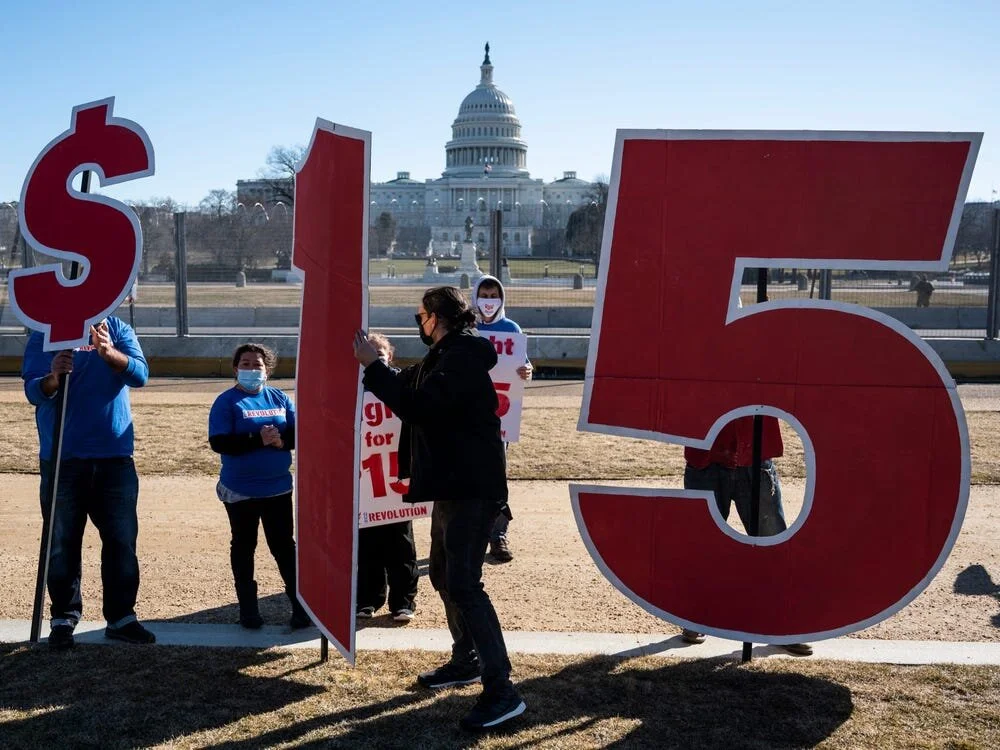
A higher federal minimum wage is not sufficient. It is time for companies to share profits with workers.
Imam or No Imam Part 2: The Emergence of Cultural Islam
At some point, a small group of wealthy Muslims came to understand that they could buy a piece of heaven (Jannah) for themselves by building Islamic centers and mosques in America. The funding individuals also found influence in their position, and with their new buildings an opportunity to tell the rest of the community how to practice our faith.
The Power of Money
Each group of individuals that built a center or a mosque brought in paid imam from their home countries, and with these imams came their cultural values too.
Saudis did not like the imam from Pakistan so they went ahead and built a mosque of their own. The Pakistanis did not like the imam from Middle East and so they went ahead and built a mosque of their own. The Sunni Imam did not understand Shia Islam and pretty soon the Shias moved ahead and build their own and the rest is history. The line between faith and culture began to blur.
In the midst of all of these mosques being built, we were raising our children and we wanted them to understand Islam, our faith in One God and in the goodness of our common humanity as God had intended, not cultural or sectarian Islam. But because of the presence of all these imams, and organized, formal spaces for prayer, the need, at least on the superficial surface, for professional Muslims began to disappear. Gone are the days of meeting and praying as part of a social engagement without regards to dress code or sectarian divide.
Sunday schools were organized, people volunteered to teach, imams came in to stake out their territory of religious doctrine and pretty soon what we were teaching our children was root memorization of the Qur’an, ritual prayers, and cultural nuances as major tenets of our faith.
Where did the meaningful discourse on the core foundations of Islam such as truth, justice and religious plurality and their relevance as citizens and as human beings in our contemporary world go?
The Consequence of Easy
It is easy to allow these new, paid Imam to take over the teaching of our faith in our shiny new funded mosques and centers. But as we have probably all learned in so many ways, the easy answer is not necessarily the right answer.
The failure of professional Muslims to take ownership of their faith in this new country and exert themselves, instead of deepening reliance on imams and sheikhs trained in overseas madrassas and other so-called Islamic universities, most of which have lost the rigor of academic institutions and have become subservient to the corrupt practices and politics of their home countries, have had serious consequences.
The majority of our children—young men and women, especially women—are leaving the mosque as soon as they can. Once they finish high school they are gone and they are unwilling to come back to a place that does not foster free thinking, imposes undue restrictions for women and is male dominated, and are led by imams who do not understand religious pluralism and led by the large donors and hyper active members to whom the imams are beholden.
What Now?
The time has come to build a different community model, a model that is participatory and calls for serious and intelligent discourse on our faith and our responsibility as citizens. Here religious scholarship is encouraged, but no fatwas are needed. Here no imam (if anyone is needed) should be on pay, and leadership has to come from the community of professional Muslims who have demonstrated leadership competency in their respective professions. Here large donors have the humility to let things evolve and not control, and professional Muslims have the courage and confidence to educate themselves in a professional manner of their faith and its relevance to our lives. Religious scholars will have a voice, but not control of the organization, and no undue respect will be demanded or rendered.
This can only happen if each one of us takes our faith seriously, and is willing to actively participate in this new model. Let’s create a new working model that can demonstrate a better alternative to “traditional” Islamic centers that have not served the larger community well.
Time has come to change course. Are you in?
Imam or No Imam Part 1: Where are the Professional Muslims?
First, the definition of a Professional Muslim in America—someone who is a citizen or a permanent resident with a college education, who has demonstrated competency and leadership, and has been accepted by their peers as a person of integrity, intellect and thoughtfulness. In addition, a professional Muslim demonstrates a deep interest in advancing his or her faith and serving the Muslim community as well as the larger community in which he or she lives.
Though this person would not fall into the category of an imam or religious scholar, I believe such a person should be given and should claim equal opportunity to serve and to lead any professional, civic or religious activities or organizations in the US based on talent, interest and a transparent selection process.
A Brief Personal History
Before we had mosques to go to in this country, we would meet at a party room in an apartment complex or in a hotel meeting room and one of the community organizers would step in and lead the prayers. There was no question of layman vs. clergy, finding someone within the community to lead prayers was not a problem.
I also remember during my days as a student at MIT, before the days of organized Muslim Student Associations and Muslim Chaplaincy, we would offer our Friday Prayers at a graduate housing complex and one of the graduate students would lead the prayer.
Maybe whoever would lead the prayers did not have perfect Arabic, but there was a sense of understanding and forgiveness for each other based on mutual respect and a deeps sense of humility—the focus was on the prayer. We did not even worry about dress code or Hijab or a Shia/Sunni divide at prayer gathering. How, as an American Muslim society today have we become horrified at the imperfect Arabic, so concerned with the dress code and justify divisions along sectarian, ethnic and racial lines, as if our prayers can not be heard by God because of these?
A Second Definition of the Professional Muslim
There has been another shift as well, a second definition we can see in the community where a “professional Muslim” is someone whose priorities have changed from their faith to their professional careers. This is understandably a quite necessary priority to have when it comes to financial stability, but at the same time, the consequence is that we are losing these same professional Muslims as leaders within our community of faith.
The Question Emerges
I remember the day when we built our mosque in Pittsburgh, the question came up who will lead prayers each day and whether we will need a paid imam or not to lead the prayer. A simple question to which many Muslims today may immediately answer “Yes.” The professional Muslims who used to lead prayers have slowly been replaced by imams. But how this came to be is a more complex and consequential explanation. We’ll explore more in our next blog.